


 08.10.2026
 8 görüntülenme
Have you ever looked at your bank account, your gold jewelry, or your business stocks and felt a little nudge in your heart? That's the awareness of Zakat. But let's be honest: for many of us, the moment we start thinking about percentages, Quorum rates, and lunar years, our brains start to feel like they've run a marathon.
Don't worry. You aren't alone. Calculating your Zakat shouldn't feel like doing your taxes in a dark room with a broken calculator. It's a beautiful act of worship—a way to "cleanse" your wealth and help those who need it most. In this zakat calculation guide, we're going to break everything down into plain English. No jargon, just clear steps to help you fulfill your obligation with confidence.
What is Zakat in Islam Explained Simply
If we look at the literal meaning, Zakat translates to "purification" and "growth." It sounds contradictory, doesn't it? How can giving money away make your wealth grow? But that's the spiritual math of Islam.
The Meaning and Importance of Zakat
Think of Zakat like pruning a tree. You cut back some of the branches so that the tree can grow stronger and produce more fruit. When you pay your Zakat, you are essentially "pruning" your wealth. You're removing the portion that doesn't belong to you—the portion that belongs to the poor—to ensure the rest of your money is blessed (Barakah).
Zakat as a Pillar of Faith
Zakat isn't just a "nice thing to do." It is the third pillar of Islam. It's an obligation (Fardh) for every adult Muslim who meets the wealth criteria. It's the bridge between the rich and the poor, ensuring that wealth doesn't just circulate among the wealthy but reaches the most vulnerable corners of our community.
Zakat etc. Sadaqah: What's the Difference?
People often use these words interchangeably, but they are quite different. Imagine Zakat is your "required reading" for a class, and Sadaqah is the "extra credit" you do because you love the subject.
Voluntary Charity in Islam (Sadaqah)
Sadaqah comes from the root word Sidq, meaning truth. It is a voluntary act of kindness. It could be money, but it could also be a smile, helping a neighbor with groceries, or planting a tree. Sadaqah benefits in daily life are endless—it rewards off calamity and brings peace to the heart.
How to Calculate Zakat Step by Step
Ready to get into the nitty-gritty? Here is a step by step zakat calculation guide for Muslims.
Understanding the Nisab (The Threshold)
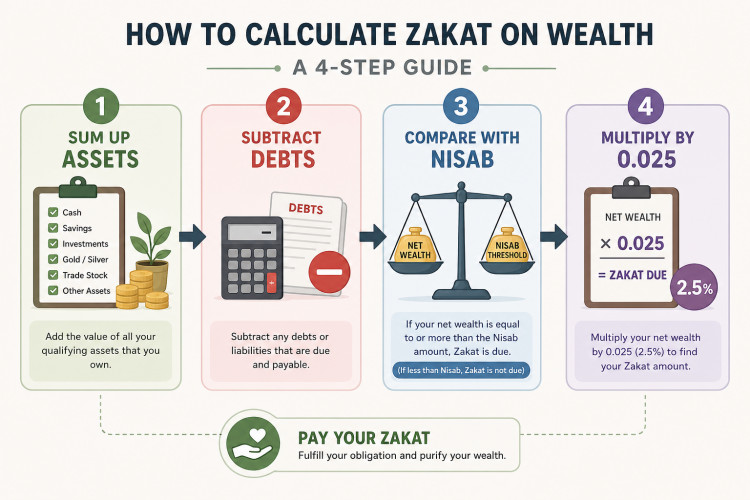
Before you pay, you need to know if you owe. This is determined by the Quorum. The Nisab is the minimum amount of wealth you must own before Zakat becomes mandatory. It is calculated based on the current price of Gold (87.48 grams) or Silver (612.36 grams).
Pro-tip: Most donations, including Al Mustafa Canada , recommend using the Silver Nisab because it allows more people to contribute to the social welfare system, helping more poor families.
Zakat Rules for Gold and Silver
If you have gold or silver that you don't use daily, or even if it's jewelry you wear (depending on your school of thought), it's part of your Zakat pool. You calculate the current market value of the weight of the gold/silver you own and add that to your total.
How Much Zakat Should I Pay on Savings?
This is the most common question. Look at your bank accounts—savings, checking, and even cash under your mattress. If that money has been with you for one lunar year and stays above the Nisab, you pay 2.5% on the total amount.
Zakat on Business Income Calculation
Own a business? You don't pay Zakat on your office building or your delivery truck. You pay on your "liquid" assets—cash on hand, finished goods ready for sale, and money owed to you by customers. Subtract your immediate business debts, and there's your Zakat-able amount!
Who is Eligible to Receive Zakat in Islam?
You've calculated the amount. Now, where does it go? The Quran (Surah At-Tawbah, 60) is very specific about the zakat distribution rules in Islam.
The Eight Categories of Recipients
The Poor (Al-Fuqara): Those with almost no income.
The Needy (Al-Masakin): Those who have some income but not enough for basic needs.
Zakat Administrators: People who collect and distribute Zakat.
New Muslims: To help them settle into the community.
Those in Bondage: To free people from slavery or human trafficking.
The Debt-Ridden: People overwhelmed by debt they incurred for basic needs.
In the Cause of Allah: For the defense of Islam or spreading the message.
The Wayfarer: Travelers stranded and in need of help.
Zakat for Poor Families and Communities
When you give through organizations like Al Mustafa Canada's Zakat program , your contribution provides food, clean water, and medical care to those who fit these categories perfectly. It's not just a donation; it's a lifeline.
The Impact: How Zakat Helps Reduce Poverty in Islam
Zakat isn't just about the person giving; It's a revolutionary Islamic social welfare system.
Why Zakat is Important for Society
Imagine if everyone paid their Zakat. Wealth wouldn't sit in bank accounts gathering interest; it would flow into the streets, schools, and hospitals. It reduces crime (by reducing desperation) and fosters a sense of brotherhood. It's the original form of social security.
Benefits of paying zakat in Islam:
It protects your wealth from spiritual "rot."
It balances the economy.
It guarantees a safety net for the most vulnerable.
Sadaqah: The Gift That Keeps on Giving
While Zakat is your duty, Sadaqah is your opportunity. Sadaqah meaning in Islam is "voluntary charity," and it is the secret to a barakah-filled life.
Types of Sadaqah and Sadaqah Jariyah Examples
There is a special kind of charity called Sadaqah Jariyah (Ongoing Charity). This is the "gold standard" of giving because the rewards continue even after you pass away.
Best sadaqah to give in Islam (Jariyah):
Building a water well in a drought-stricken village.
Supporting an orphan's education.
Planting fruit trees for a community.
Building a mosque or school.
10 Powerful Benefits of Sadaqah in Islam
Forgiveness of Sins: It puts out sins like water puts out fire.
Protection: Sadaqah for health and protection is a well-known concept in the Sunnah.
Shade on Judgment Day: Your charity will be your canopy.
Cures Sickness: The Prophet (PBUH) told us to treat our sick with charity.
Ease in Hardship: Giving when you are poor opens doors you never imagined.
Increases Wealth: Paradoxically, the more you give, the more you get.
Angels Pray for You: Every morning, angels pray for the one who gives.
Softens the Heart: It removes the love of the dunya.
Barakah in Time: Your days become more productive.
A Way to Jannah: There is a specific gate in Paradise (Baab As-Sadaqah) for those who give.
Practical Tips for Giving Charity in Ramadan
Giving charity in Ramadan is like planting seeds in the most fertile soil imaginable. The rewards are multiplied by 70 or more!
Automate your giving: Set up a small daily Sadaqah so you never miss Laylatul Qadr.
Clear your Zakat: Many Muslims choose Ramadan as their "Zakat Anniversary" to maximize the reward.
Feed the Fasting: Providing Iftar is one of the most beloved acts. Check out Al Mustafa Canada's Food Appeals to see how you can help.
Choosing a Trusted Partner: Al Mustafa Canada
When it comes to your Zakat, you want to be 100% sure it’s reaching the right people. Al Mustafa Canada is dedicated to transparency and impact. Whether it’s emergency relief, healthcare, or supporting widows, they ensure your Islamic charity system obligations are met with the highest standards of integrity.
You can even use their resources to find a sadaqah donation idea for Muslims that resonates with your personal values.
Conclusion: Your Path to a Purified Wealth
At the end of the day, Zakat and Sadaqah are not about the numbers on a screen; they are about the state of your heart. By following this zakat calculation guide, you’re taking a huge step toward spiritual maturity. You’re acknowledging that everything you have—every cent, every gold ring, every business success—is a gift from Allah, and you’re happily sharing that gift with His creation.
So, take a deep breath. Grab a pen. Use the steps we discussed. And as you click "donate," feel the weight of the world lifting off your shoulders. You aren't just paying a bill; you're building your palace in the hereafter.
Frequently Asked Questions (FAQs)
1. Can I give my Zakat to my parents or children?
No. Zakat cannot be given to your direct dependents (parents, grandparents, children, or grandchildren) because it is already your legal responsibility to provide for them. However, you can give Zakat to brothers, sisters, aunts, or uncles if they fall into the eligible categories.
2. Do I have to pay Zakat on the house I live in?
No. Zakat is not due on your primary residence, your car, or the tools you use for your trade. It is only due to "growing" wealth like cash, gold, silver, and business inventory.
3. What if I missed my Zakat for previous years?
If you realized you haven't paid Zakat for past years, you should calculate what you owed for those years and pay it as soon as possible. It remains a debt to Allah until it is settled.
4. Is there a difference between Zakat and Zakat al-Fitr?
Yes! The Zakat we discussed here is Zakat al-Mal (on wealth). Zakat al-Fitr is a small, flat-rate donation (usually around $10) that every Muslim must pay before the Eid prayer at the end of Ramadan to ensure the poor can also celebrate Eid.
5. How do I calculate Zakat on stocks and shares?
If you are holding stocks as a long-term investment, you generally pay Zakat on the "liquid" assets of the company. However, for most people, it's simpler to pay 2.5% on the current market value of your portfolio if you intend to trade them. Consult a scholar or use a specialized calculator if your portfolio is complex!
Yorumlar (0)
Bu gönderi için henüz bir yorum yapılmamış.
Yorum Bırakın