

 09.04.2026
 935 görüntülenme

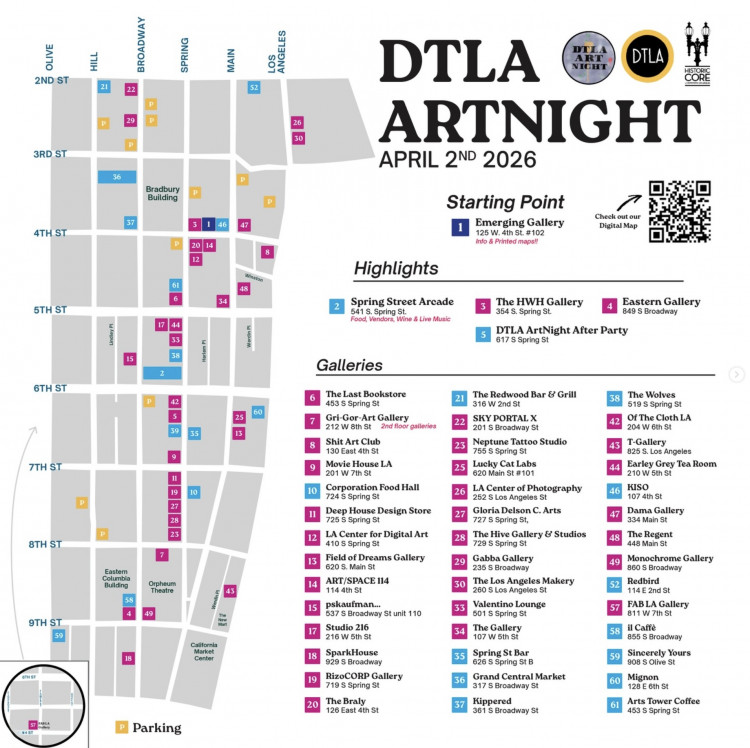
It was the evening of April 2nd, a Thursday. I was visiting the registered galleries for Downtown Los Angeles Art Night. Commonly encountered across the United States, art night/walk events are organized by city arts councils or volunteer initiatives, bringing together galleries located within a walkable district to present existing and/or pop–up exhibitions to the public, forming a cohesive and enjoyable intersection of art and social engagement.
Not only galleries, but also restaurants, cafes, tattoo/yoga/wellness studios, and retail spaces participate in these events. Institutions that do not normally operate within the arts may also take part, often through open calls, temporarily exhibiting works by artists on their walls. For locations with a high volume of production, this constitutes a highly functional model of solidarity.
For this month’s program, 61 venues had registered [some of which appeared not fully installed even at the last minute, or entirely closed to visitors] and were announced via social media and websites. Although opening hours varied between 4–6 pm depending on the venue, some galleries admitted visitors earlier, while others continued installation until the final moments. I had not even visited ten galleries when, on W 8th St, I experienced my first racist encounter in the United States.
During my travels in Europe, when asked where I was from and I answered 'Turkey', I had frequently encountered the comment: "You don’t look Turkish". Even with my background in sociology and philosophy, I never classified this [even at a micro level] as racism, and I corrected those who did. Stereotypes, after all, have causes. The European experience had largely been shaped by earlier generations of Turkish immigrants who lacked motivation for integration, did not follow local norms, favored their own communities, resisted learning the language, and showed almost no respect for the culture they had entered. Thus, when Europeans encountered someone speaking English or another foreign language fluently, forming coherent sentences, behaving respectfully, and aligning with Western standards, they struggled to reconcile that person with their notion of being Turkish. Within historical context, it was understandable, a perception that could evolve over time.
In harsher, more intolerant forms, I had encountered two such incidents during trips to the UK in 2002 and 2016: one an explicitly xenophobic physical assault, the other stereotype–based discrimination.
However, in a way that most people would not encounter, no one had spoken to me about skull measurements until I reached the age of 38/in 2026. Had I told this story in the Middle East, including the Turkey I was born and raised in [where communication often contains a high degree of toxicity] it might have been dismissed merely as 'provocation'. In contrast, in first–world contexts such as the United States or Europe, this language is categorized as unacceptable racism.
When I first arrived in Los Angeles, both American and Armenian friends had warned me that in certain areas I might encounter fanatical Armenian rhetoric and should be cautious. Up until the late 1980s, the ASALA terrorist organization [targeting Turkish individuals globally] had carried out its first assassinations in this region, killing Turkish consular officials in 1973 and 1982.
In the four years I had spent in the United States [one of them in Los Angeles] I had not encountered any discriminatory or racist discourse until that day. During that time, people [who had immigration histories] had occasionally attempted to guess my identity, usually asking whether I was Persian, Greek, or Armenian. Given the close genetic proximity of the region [and the friendly tone of such exchanges] and considering that in Europe we are generally not overly sensitive to such questions, these experiences had never become particularly disturbing. I had also had warm and relaxed interactions with Armenian artists and writers I met in LA. The possibility of encountering racism [particularly in California, often described as the most progressive state in the USA, and within the art world] had simply never occurred to me.
I had passed by this gallery before, but had assumed it was closed due to the extremely dirty windows and the chaotic interior. This time, within the scope of Art Night, I also had the opportunity to record it for my YouTube channel and add it to my archive. I did so. Even if mediocre, I aimed to include all forms of artistic content that I could later use as examples in my lectures.
When I entered, two people were talking. I began looking at the works. One of them left; the other approached me. He asked my name and where I was from. I told him. “Your name doesn’t sound Turkish, and you don’t look Turkish either. Turks have slanted eyes, like Mongols”, he said, narrowing his eyes with his hands to demonstrate. “Nationality is based on culture and language”, I replied, adding that even the ethnic racism he referred to was outdated [circa 1920].
I initially thought he might be referring to Central Asian Turkic populations, but Armenian interaction had historically been more with Anatolian Turks. Then I recalled: within the Armenian education system, anti–Turkish narratives [framed through themes of barbarism and post–Central Asian occupation] were instilled from early ages. The most bizarre part of the encounter, without question, was when he leaned forward to look at the back of my head and said, “Turkish skulls are not shaped like this”. When I later told my American friends, they were genuinely upset on my behalf, yet we ended up laughing when they remarked, “Even his racism is outdated and reactionary”.
Turkish identity had long ceased to be a defining element of how I described myself or formed my sense of belonging. I did not know how he imagined the interaction would end, but I was certain he intended to provoke me. There is a saying: “When you argue with a fool, it becomes unclear who the fool is”. One cannot spend unlimited time correcting every ignorant idea or incompatible viewpoint. There will always be texts and works produced from positions one disagrees with.
When the conversation shifted to the fact that I work across sculpture, painting, installation, print, video, and photography [and that my art and books have been repeatedly censored in Turkey] he said he knew of an artist named Bedri from Turkey [referencing an older exhibition]. I asked if he meant Bedri Baykam; he confirmed. I told him that four of my works are in his collection. He then claimed that “There is no such thing as Turkish art”. I told him to ask Google. Whether or not one appreciates it [and although it may be difficult to disentangle due to imperial legacies] such a thing does exist. We simply do not frame our practice in nationalistic terms.
When I said I would continue visiting other exhibitions in the art walk, he asked to see my work. I told him I did not have time, handed him my business card, and said he could view it on my website. He began asking detailed questions: how I moved to the United States, which neighborhood I lived in, even location. I did not answer most of them, partly due to a lack of trust, and partly due to the unpleasant odor of onions emanating from his close proximity.
As I moved toward the exit, he suddenly stepped in front of me and said he wanted to take a photo of me with a sculpture [located in the gallery], under the pretext of painting my portrait. I don’t know about you, but I don't consider it safe to appear in the camera roll of someone who comments on my skull shape. When I told him he couldn't take that pic, he replied, “But you’ve been filming my gallery for the past few minutes”. I explained that the venue had registered for the art walk, had requested visitors, was publicly listed, and had its doors open, therefore I could document publicly accessible spaces for artistic purposes. I added: “I am not a public image here”. He still pointed his camera at me; I covered it with my hand, from a short distance without touching. In a cunning tone, he said, “I left the door open for air, you came in”. The intent to provoke had by then become breathable.
As I reflected [partly evaluating the day, partly critiquing the language used] I asked myself what exactly had disturbed me. If this man had made ignorant remarks about Turks within a private message group among friends, it would not have concerned me. One cannot track down and correct every stereotype or the individuals who propagate them.
In many aspects of our lives, we have either been subjected to or contributed to such categorizations, whether accurate or not. It is something one can work on once recognized, and I did not dwell on that either. Had he asked in an open, dialogical manner [“I thought Turkish skulls were…, their eyes…”] I would have responded without being as disturbed. I would have found it odd, certainly, but if I sensed good intent, I would have engaged, perhaps even treating it as a sociological observation.
No, the disturbing element was not ignorance or boundarylessness; I had encountered those many times before. What disturbed me [beyond the onion odor] was being told what I am or am not, the bully structure of his communication, and, of course, his attempt to forcibly photograph me while asking for my address. As someone who advocates for the limitless nature of freedom of expression, I still hold that position. What I expect, however, is not restriction of content, but a balanced language within collective interaction.
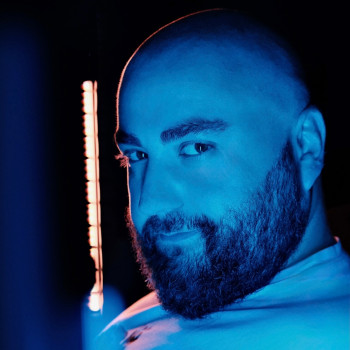
April 2026, Los Angeles * Cover photo: Erhan Us
Yorumlar (0)
Bu gönderi için henüz bir yorum yapılmamış.
Yorum Bırakın