

 20.02.2026
 357 görüntülenme
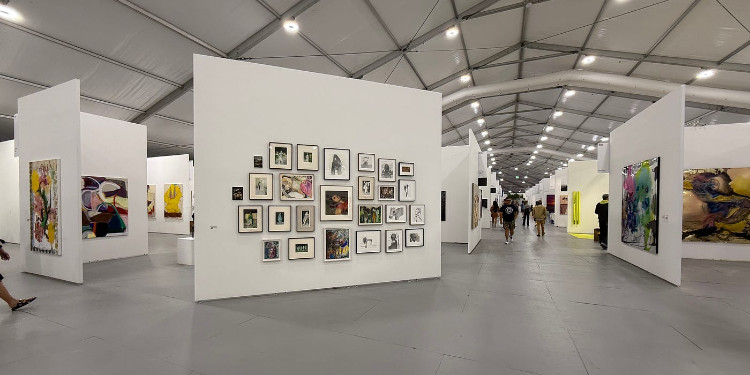
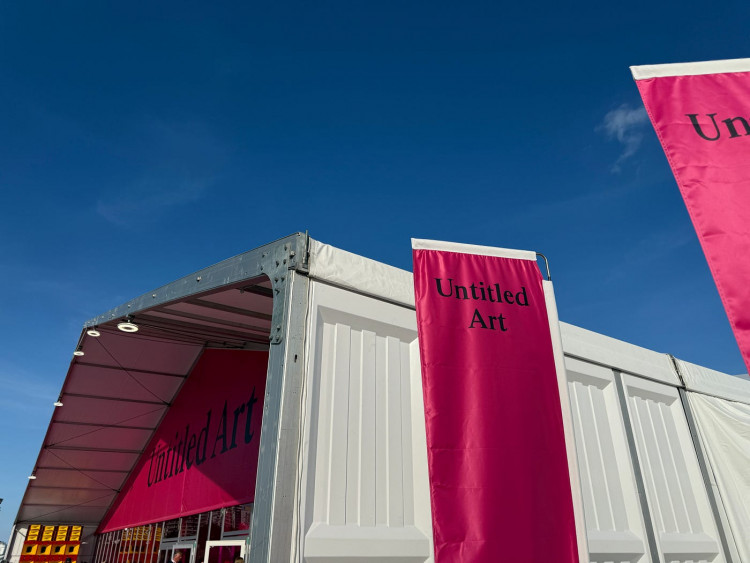
With less than two weeks to go until the 14th edition of Untitled, let’s first take a look at the previous event. December 4–8, 2024, Miami Beach, Florida. I had mentioned that among Miami Art Week fairs, I had three favorites: NADA, INK Miami, and Untitled.
Immediately on the left at the entrance [00:20], a work different from the usual fair visuals, Federal Cleaning by Reynier Leyva Novo, draws my attention. While working in 2024 in Washington D.C. under the Smithsonian Artist Research Fellowship, Novo carried out a project in which he collected dust from some of the most important federal buildings and national monuments in the United States. He highlighted that historically, D.C. represents the political center of the nation, and that this city, designed by Pierre L’Enfant in the 18th century, with structures like the White House, the Capitol, and the Supreme Court, is the heart of the country’s governance. In this context, Federal Cleaning is a project that produces a series of works using dust collected from spatial symbols of power and political authority. Comprising 14 pieces, the series aims to reveal the transience and effects of time behind the seemingly grand and solid architecture of federal institutions. Dust accumulates on these structures as a result of both human and environmental interaction, representing an invisible yet constant change. The artist sees the dust not as ‘waste,’ but as a historical record of the slow and inevitable transformations these buildings undergo. In each piece, the carefully arranged dust on adhesive paper turns the traces accumulated on the surfaces of these powerful institutions into a tangible document. In this way, the artist reminds us that even the most powerful political structures, no system, or form of authority is resilient against time. The project encourages the viewer to contemplate the fragility of authority, the fleeting nature of power systems, while exposing the tension between the grandeur of major political spaces and their inevitable decay and transformation over time, visualizing how temporary and dependent on humans and the environment authority truly is. The work was presented to viewers by El Apartamento.
Photographic works by Miguel Braceli [01:49] also serve as a flag bearer for the survival of the medium in a market dominated by painting and sculpture. The artist’s architectural background and multidisciplinary practice add vision to the booth. Yellow ropes perfectly cancel the space form between the floor and the wall. While the viewer wonders where to stand in front of the screens (video art) and photographs and becomes curious about the story, the catalogues and texts presented on the floor [outside the usual tables], along with exposed cables, reflect the trust in the project.
House of Chappaz from Barcelona, knowing how color affects attention [05:42], painted a background pink; at first glance, one might think the works are made of sponge. Carmen Ortiz Blanco’s rubber works on metal supports, with prices ranging from 4,000 to 30,000€ according to current gallery website data. The artist’s practice is built on highly thoughtful and transcendental art–making shaped by a philosophical and aesthetic perspective. In her works, she explores themes such as human transience, fate, time, and the consequences of actions, framing this inquiry both for herself and as questions opened to the viewer. Her series offer viewers opportunities to think on both metaphysical and concrete levels, using slightly open doors, geometric structures, and architectural metaphors. In her sculptures and installations, durable materials like laminated steel are processed using origami–like folding and cutting techniques, resulting in works that convey a sense of delicate balance and uncertainty rather than rigidity. I hope the fair was productive for the gallery and the artist, as the logistical and managerial moves, such as dedicating the booth to a single artist, were ambitious.
In José Vera Matos’ practice [12:55], text emerges as both a conceptual and visual building block; the artist uses text not only as readable content but also as a formal material. Transferred by hand, often with very fine pens onto surfaces resembling bamboo paper, the texts are arranged with such intensity and rhythm that the writing gradually loses readability and becomes a visual architecture. Repeating sequences of letters form columns, weaves, and geometric patterns; while the text conceals meaning like an inner vibration, on the surface it becomes an abstract composition directly connected to the artist’s investigations into post–colonial identity, multilingualism, ruptures in cultural memory, and power relations in language. Matos rewrites texts from authors referencing Peru’s history and the cultural layers of its mestizo identity, tracing the visual imprint of these historical discourses. At the same time, by using the architecture of pre–Columbian patterns, he constructs the text as both a cultural and spatial structure; transforming the text from a document into an almost built surface, a rhythm. In this way, the text itself exists both as a way of thinking and as a concrete form, allowing the viewer to experience oscillation between reading and simply observing.
Amor Munoz’s presentation, sponsored by INFINITI [13:44] offers viewers an experience in which works by the artist appear projected onto a new QX80 using projection mapping, visible between curtains as one enters. While I enjoy seeing projection–based works, I expect the experience to be absorbed holistically by the viewer.
Huge brand sponsorships provide artists access to materials and works they design, but when the work itself is collided with marketing methods, the result often remains a consumer object and a social media experience. Even if the artist feels satisfied PR–wise, the long–term impact on their career is like appearing in an underwear ad. While no one remembers the product or concept, the viewer does not forget what they desired. Marketing strategies succeed because they seek emotional engagement, yet this market condemns artists without networks to remain undiscovered.
Project K, a Seoul-based gallery [14:08], prepared a calm and simple booth. During the fair, the documents I requested and quickly received were professionally prepared with detailed information and photographs. Ha Jin Lee’s works present a narrative exploring the relationship of the human body with social and cultural power dynamics, blurring boundaries between body/inside and world/outside; the body is presented as a space shaped by societal norms and gender–based power structures. Within this framework, focusing particularly on the female body, the artist addresses themes of dominance, power, and minor resistances; the №2A work made from black nylon thread demonstrates the body’s interaction with the world, revealing invisible power dynamics and a marginal perspective. This practice also engages with themes of memory and trauma. Mnemosyne, as a physical representation of the body, reveals violence against women; scratches on wooden pieces evoke past traumas and repressed experiences. Here, experiences that cannot be verbally expressed are effectively communicated through visual and physical language. Ha Jin Lee’s exhibition builds a narrative around body and memory, questioning the effects of societal norms and power relations on the individual, conveying resistance and freedom through both concrete and abstract materials. The artist’s story engages shared human experiences across Eastern and Western cultures, inviting the viewer to participate physically, mentally, and emotionally in these experiences.
Women are systematically pushed to a secondary/subjugated status in every society, using collective structures, religion, family pressure, and economic inequalities as tools. Escaping traditional roles in collective societies is nearly impossible, and we can see fingerprints of religions in this crime in the Middle East and the West. I have made countless critiques and studies on patriarchal violence directed at women and Q+ individuals, yet in my experimental short film Portrait of My Unborn Sister [2025], I expressed most clearly: No society can achieve gender equality while adhering to texts that teach Eve was made from Adam’s fragments. — In memory of femicide victims in Turkey.
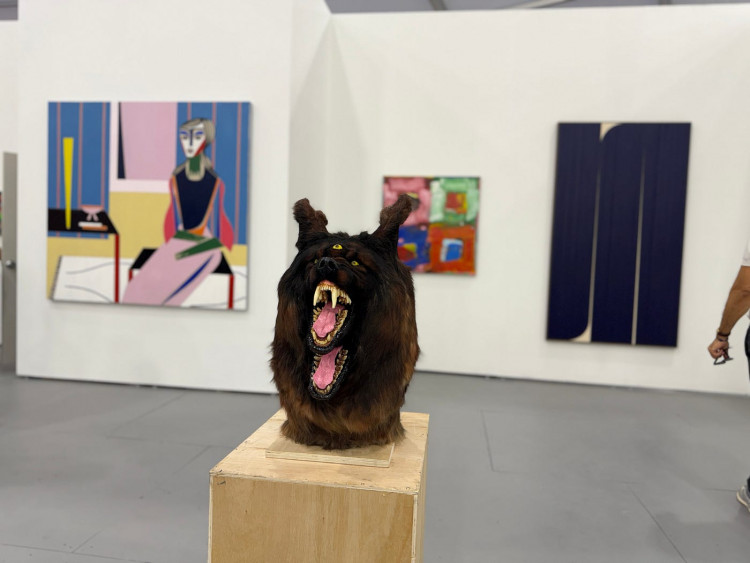
Regarding the fair overall, galleries are obsessively attached to the ‘eye level’ tradition. While I encountered a few examples that stood out with new ideas, one must reflect on misused spaces. Galleries! Don’t think of booths as if they were 21:9 films; you can use every inch, guide the viewer up, down, sideways, into corners, creating enjoyment during the experience. Aligning works side by side at the same height only gives the impression of an elderly hobbyist painter.
At the Vin Gallery booth [14:47], active in Vietnam and China, I noticed a manipulation of Christ on a cross, which caught my attention as an atheist artist who often plays with religious symbols. UuDam Tran Nguyen’s sculpture IGWT (In ‘God’ We Trust) is inspired by a Christ figurine encountered in a church gift shop. The sculpture is wrapped in clear plastic to protect it from dust, which seems to alter the figure’s meaning. The plastic makes the sculpture both familiar and ambiguous; is it a classic Christian icon, or has it become something else? The artist recreated the scene in bronze, presenting the plastic–covered sculpture and cross together on the floor. While the resulting work still resembles Christ at first glance, it raises deep questions: Is this still a sacred Christian figure? Is Christ truly beneath the plastic or exterior, or has the figure transformed into something else? Who or what do people truly believe in; do they trust without seeing? The sculpture intertwines themes of faith, worship, and commercial value, providing an experience that challenges viewers to think beyond what is visible and confront the question “What’s beneath?” Additionally, the positioning of video works in the booth demonstrates that placing TVs on the floor or in corners can also be effective presentations.
Speaking of manipulations on Christ sculptures, another interpretation is seen in Carlos Aires’ Il Mondo at Zilberman [56:33].
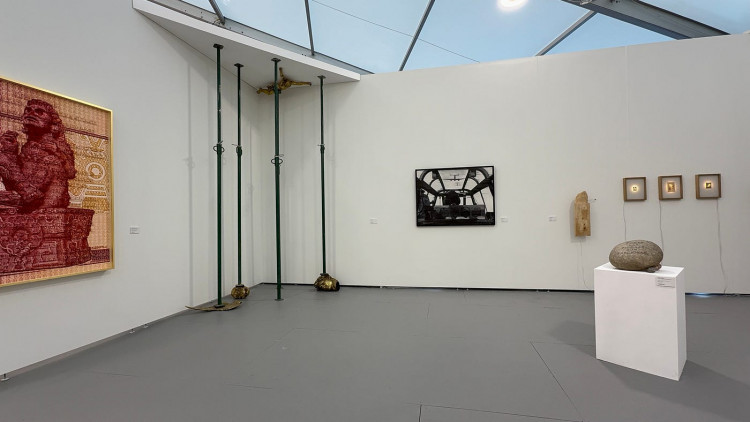
As a medium, it was a successful fair for video; I saw works on many different screens. Only at Max Estrella did I encounter Rafael Lozano–Hemmer’s [23:18] Recurrent First Dream, completed in 2024, which was impressive both in content and format. The work is an algorithmic animation inspired by Mexican poet Sor Juana Inés de la Cruz’s 1692 poem Primero Sueño, exploring feminism, human desire for knowledge, and rational thought. The poem’s main theme is the elevation of knowledge. Sleep is treated as a pleasure experienced not only by humans but by the entire universe. Lozano–Hemmer uses a two–layered language in the piece: the lower layer contains Sor Juana’s poem, while the upper layer spreads golden words across the screen like ribbons moving according to fluid dynamics mathematics, creating a slow–moving flame effect. The result is a visual experience in which words appear randomly, forming an ascending vortex. The work invites viewers both to explore the poem and to experience Sor Juana’s visionary ideas. Recurrent First Dream explores knowledge, transcendence, and the female perspective through digital and moving visualization, placing the viewer at the center of the poem and the poet’s vision. I last saw the artist’s Obra Sonora exhibition at The Baker Museum / Florida, where the use of interactive technologies was particularly breathtaking [available on YouTube].
At the UK–based TAEX booth, Kevin Abosch’s Implied Narrative [26:46] is a video and visual experience focused on AI and human identity. The artist used his hands as a structure or ‘skeleton’ to create AI–generated images and video sequences. These hands provide both a physical reference and a visual frame; when AI produces a layered, multidimensional visual language using this frame, the work deliberately avoids telling a clear story, leaving space for viewers to interpret and associate meanings. Abosch, combining the personal and abstract through AI, turned the morphology of the hand into data; the hand becomes a form implying multiple narratives representing human experience, actions, and memory, both universal and individual. The work presents an open–ended visual narrative exploring human existence and experience through the symbolic power of the hand combined with AI production. The booth also featured the exhibition Data Sovereignty is a Human Right. The exhibition addressed the current and critical issue of data sovereignty and the protection of personal data. Here, ‘data sovereignty’ is presented as the right of individuals to control their own digital data, emphasizing that this right is a human right. Unfortunately, within the triangle of technology developers–mega corporations–lawmakers, the individual has no priority, and gains in rights will take a long time. The space included works by Krista Kim, Kevin Abosch, and Sasha Stiles, visualizing the societal impact of technology, data privacy, and ethical issues arising in the AI era. In a world where fair attendees come primarily to buy ‘beautiful paintings’, seeing conceptual and video works presented at this level of professionalism is promising for the sector.
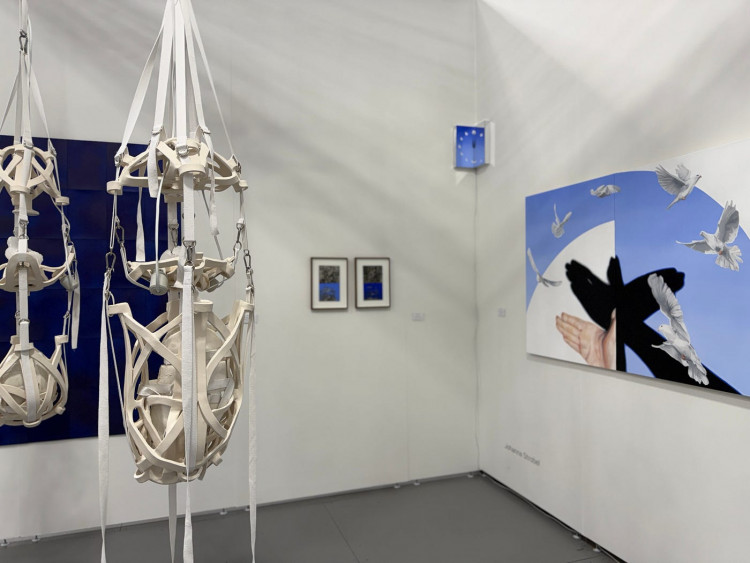
Galerie Isabelle Lesmeister [36:24] participated in Untitled from Germany with Johanna Strobel. The artist focuses on time. In her work, she examines theoretical concepts such as change, entropy, and information through mathematics and information science, and her bilingual experience, focusing especially on capitalist notions of time: individual and social time in society is regulated and accelerated by clock economy. At the same time, ecological time changes due to human–induced climate crises, destabilizing ecosystems. Strobel, by following the timelines of animal characters, explores connections between philosophy, semiotics, and current reality, combining elements from different histories and geographies to produce surrealism through knowledge, making science part of imagination. The artist addresses cultural, historical, and ecological intersections with humor, logic, poetry, and knowledge, creating conceptual, linguistic, and visual paradoxes. These works generate both intellectual and visual experiences of different dimensions and measures of time, its relationship with knowledge and ecology, through an interdisciplinary approach.
Regarding gallery/curatorial operations, there is a blockage: when visiting fairs or galleries [as I have repeatedly emphasized the importance of the ‘story/background of the work’ in my previous texts], if the catalogues or wall labels only contain Artist/Title/Year/Dimensions/Technique/Price, I request texts from the gallery about the artist and work. These emails usually reach me the week after the fair. While writing my texts, I also review attached files in the relevant emails, adding information to the article if something is missing. These files are mostly PDFs stored in Google Drive, which is the most functional choice. One frequent problem: no matter the gallery cloud system [Dropbox, Google Drive, etc.], folders must be organized. If you are managing an operation here and using link–based file integration in emails, that file must remain accessible whether the email is opened today or next year. Every time a gallery changes the links and extensions shared with an artist/collector/viewer, it disrupts the ecosystem of the artist who presents it or references it on their website. When these emails are shared with press/collectors/viewers, they cannot be made accessible for only a few weeks. The second problem: I have requested these files due to missing information in the catalogue. I open the file: Photo/Artist/Title/Year/Dimensions/Technique/Price! In other words, the gallery does not care why, with what motivation, or with what concerns the artist created the work. They take the final version, do the photoshoots, put it in the file, and send the links. The context, which may contain countless stories and propositions, is reduced by the gallery to “If you hang this on your wall, it looks perfect; the price is $8,000.” Then you wonder why audiences distant from art cannot bond or say “Is this even art?”. If the context is preserved, at least the idea would satisfy us.
Yorumlar (0)
Bu gönderi için henüz bir yorum yapılmamış.
Yorum Bırakın