


 11.03.2026
 317 görüntülenme
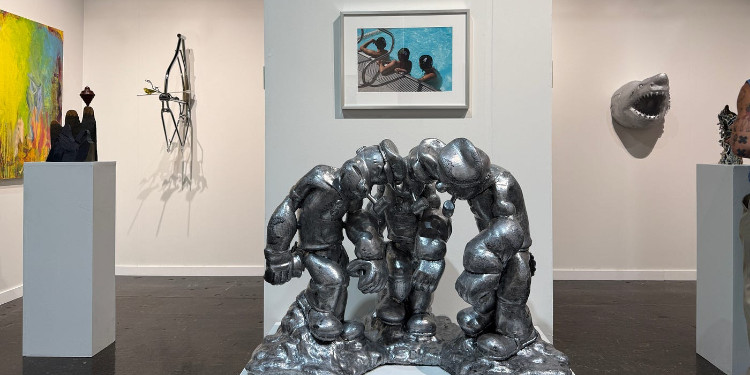
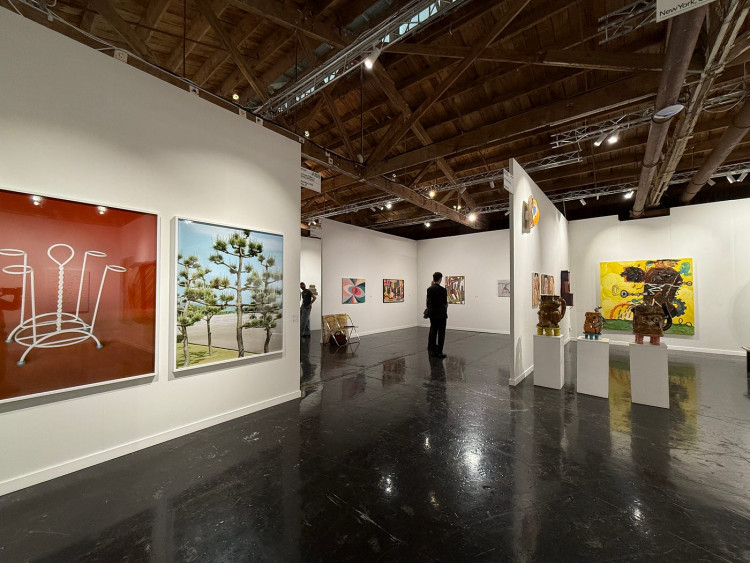
NADA Miami, or the New Art Dealers Alliance, is a major contemporary art fair held annually during Miami Art Week. It’s also my personal favorite due to its professionalism and spaciousness. In this article, we’ll revisit impressions from the fair held December 3–7, 2024, at Ice Palace Studios, marking its 22nd edition with 151 participating galleries.
Nearly 20 fairs take place during Miami Art Week, almost all within a ten-day span. I had mentioned that NADA is my favorite alongside Untitled and INK Miami. The reason: unlike other fairs, you’re not exposed to amateurish or hobby–level works that seem out of place. From the entrance onward (both outdoors and indoors), there’s no sense of rush; a slow, positive flow as if people around you came to the beach to relax. The most successful adaptation of socializing and networking throughout the week was seen at NADA and Miami Digital.
Textile–based works frequently caught the eye on the floor. In a market where painting, sculpture, and installations have serious representation, the use of fabric and soft sculptures is an excellent choice for a fair. Paper/prints, video, and photography follow these media in prevalence. For galleries coming from abroad, textile works are rare opportunities. Two–dimensional pieces are easy to hang, while three–dimensional works can be filled or inflated, with no risk of breakage or deformation, and are often washable. Additionally, 2D works cover walls, while 3D works, placed on pedestals or on the floor, easily transform a gallery booth into a satisfying experience.
Looking at the Patel Brown booth [11:53], the variety was well balanced despite the works sharing a similar visual language. Michael Dumontier and Neil Farber’s large–scale, grid–based paintings attracted significant attention, and I was among those viewers. Four works composed of square paintings were on display; some forming a single large fixed image, others small squares that look like they could be rearranged without disrupting the experience. The works demand the viewer’s focus. If attention is not given, ready–made objects revert to their functional roles, losing their status as art. When rugs and carpets first entered the art world, detaching them from Orientalist perspectives was crucial; they had to become visual tools conveying a concept or pleasure rather than serving their original function. At that point, viewers want more than “Scan the QR code for work information”.
I’ll discuss QR code usage in more detail in later articles. However, if artwork and artist information aren’t on the wall and the experience relies solely on QR codes, it’s essential that mobile operator connectivity and Wi–Fi be accessible and inclusive. International visitors may lack mobile internet, and most fairs don’t provide wireless access. Realistically, photographing a QR code to check later at the gallery is neither common nor practical.
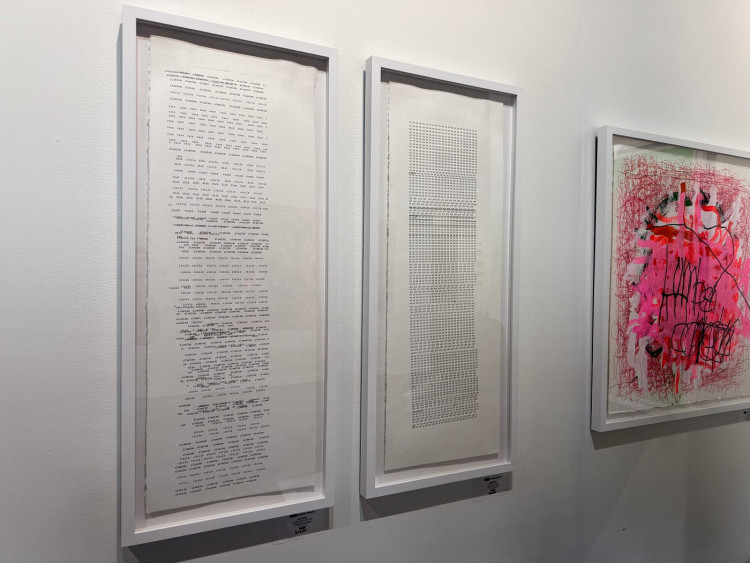
At the CARBON.12 booth from Dubai [2:52], Philip Mueller’s painting Bad Gastein Afterhour 23 was among the works I enjoyed most. A man in knight’s armor, a female wolf figure in an empty pool. Works like this, with numerous elements, signal a significant narrative. The way it’s displayed must align closely with the story; otherwise, viewers interpret the painting like reading coffee grounds, leaving the experience incomplete. Certain impressions are too valuable to leave to the uncertainty of scanning a QR code.
Kevin Sparkowich’s Forgery [combining a rifle case, Moleskine notebooks, and locks] dominated the booth [3:36], capturing all the viewer’s attention. Decorative works are familiar, and the market is full of them. But pieces like Forgery are unicorns. This time, the label wasn’t placed around the work, but the text itself exists within the piece, explaining it. Yet more detailed information was necessary for other works by the same artist in the booth.
At that time, Sargent’s Daughters, operating in New York and Los Angeles (before withdrawing from LA), hosted Yaron Michael Hakim’s works on identity. The artist’s new pieces consisted of paintings on recycled sailcloth and sculptures made from gourds grown in his garden, centered on his personal and familial roots in Latin America. Born in Colombia and adopted as an infant, Hakim moved across three continents as a child, distancing him from his origins. In this series, Colombian fruits were anthropomorphized into portraits replacing the faces of his unknown birth family. The presentation naturally placed the 2D works on walls, while a suspended gourd in between served as a memorable, complementary positioning. The narrative I mentioned above was conveyed by the gallery, though not included in the wall label.
The often–overlooked patronage system [offering artists long–term support] was a historical model under pressure in today’s fast–paced art market. Jonas Lund, creator of one of the fair’s most conceptually significant series, reinterpreted this tradition in a contemporary way. In his project Jonas Lund Token (JLT) Futures [13:12], collectors purchase works the artist will create in the future. These works are tokenized via blockchain contracts, turning them into investment instruments. While the artist’s website might appear complex with user logins and token integration, on OpenSea, the largest NFT marketplace, you can review works and check portfolio volume [5.73 ETH]. Each JLT Futures contract contains a unique agreement between the artist and collector, specifying dimensions, materials, and delivery dates, while leaving form and content undefined. This model allows artistic freedom while offering collectors an investment in the artist’s future. Upon contract expiration, each token transforms into a physical Lund work. Throughout my career, I’ve seen galleries often seek to intervene in an artist’s production process, disturbingly so. Some artists maintained their line, while those producing solely for sales remained silent, almost like wall painters. Lund’s project is highly functional and transformative for the sector. According to the explanation, work quality is rated A–AAA by an independent JLT board. This system allows collectors to ‘purchase the artist’s present time, taking time from their future self’ while giving them a stake in the artist’s future. The combination of visual and textual elements makes Lund’s project not just a financial or technological experiment, but a concept exploring the human dimension of artist–collector relationships, optimism for the future, and the continuity of creativity. As you know, galleries rarely introduce artists to collectors directly to avoid losing commissions. Annka Kultys Gallery has made a notable effort here in confidence–building, creating space for the artist, and visionary practices.
Yorumlar (0)
Bu gönderi için henüz bir yorum yapılmamış.
Yorum Bırakın